Dandadan Fansub Ep 12 Translation Notes
Final episode of the season! After this, I’ll take a bit of a break to get a head start on season 2 so I can release on a weekly cadence again. I have a lot of social plans coming up so I will probably need some time to get through those as well. Anyway, onto the translation notes!
Something I always find interesting about translation is choosing how to handle loanwords, or when characters speak languages other than the main language of the text. In a Japanese TV show, if there’s a sign written in Mandarin, that’s intended to be semi-comprehensible to a Japanese audience (due to some shared characters and meaning), how do you render that when the Japanese has been translated to English? Ideally, context permitting, I’d want to translate the sign to something which shares cognates with English, like Spanish, French, or German, but it’s a tricky decision!
Japan’s relationship with the English language is unlike anything in the shared Anglosphere — complete cultural saturation and familiarity. Every Japanese student learns English in school, and Japanese products are often labelled with English names in favour of Japanese. While some regions may have an equivalent, like Spanish for certain areas of the US, or French in Canada, there’s no universal equivalent, especially for Australian English which is predominantly the variant I’m translating into. So a common problem I encounter is how to translate English that appears in my source material.
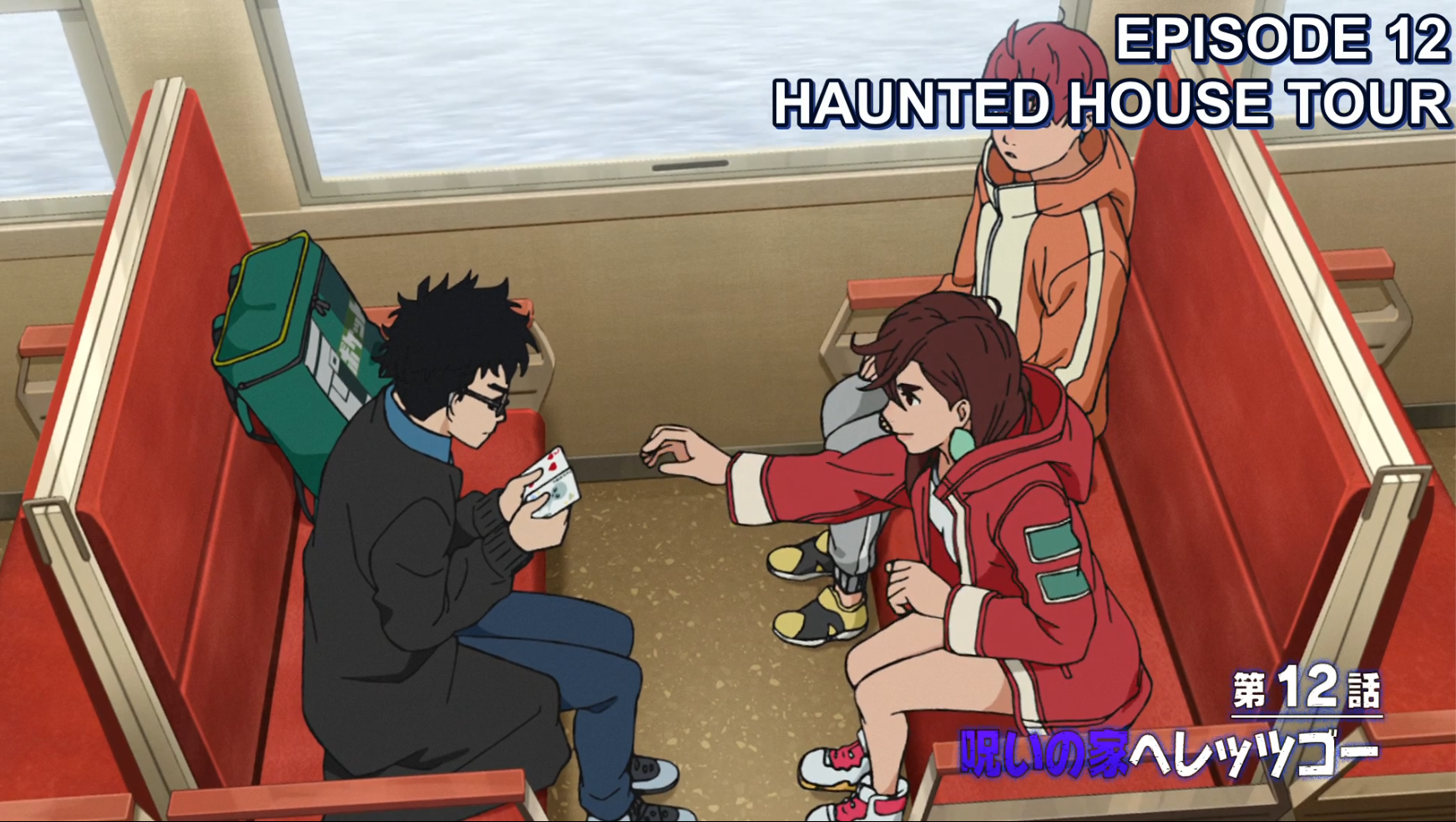
The name of this episode is 呪いの家レッツゴー. 呪いの家 is “cursed house” or “house of the curse” and レッツゴー is a Japanese transliteration of English “let’s go” (rettsu-gō). It makes sense why the official translation of this title is “Let’s go to the cursed house”. But that sounds like standard English, while the Japanese title sounds like non-standard Japanese. I believe レッツゴー is at least partially in common usage thanks to it being one of Mario’s catchphrases, and it certainly carries that vibe of being unserious and fun. I think of particular note is the fact that the title sounds like it’s written in Jiji’s YouTuber register — language like this could easily be prominently featured on a thumbnail or video title.
Due to this, I chose to translate it as “Haunted House Tour”. “House tour” carries YouTuber associations and sounds like something Jiji would say, and I was happy with how the careless frivolity of framing it as a house tour contrasts with the actual horror of the house. That seems to be the intent with the original Japanese title — Jiji optimistically encouraging the group by shouting 「レッツゴー!」 to cover up his fear and anxiety over the house and its spirit.
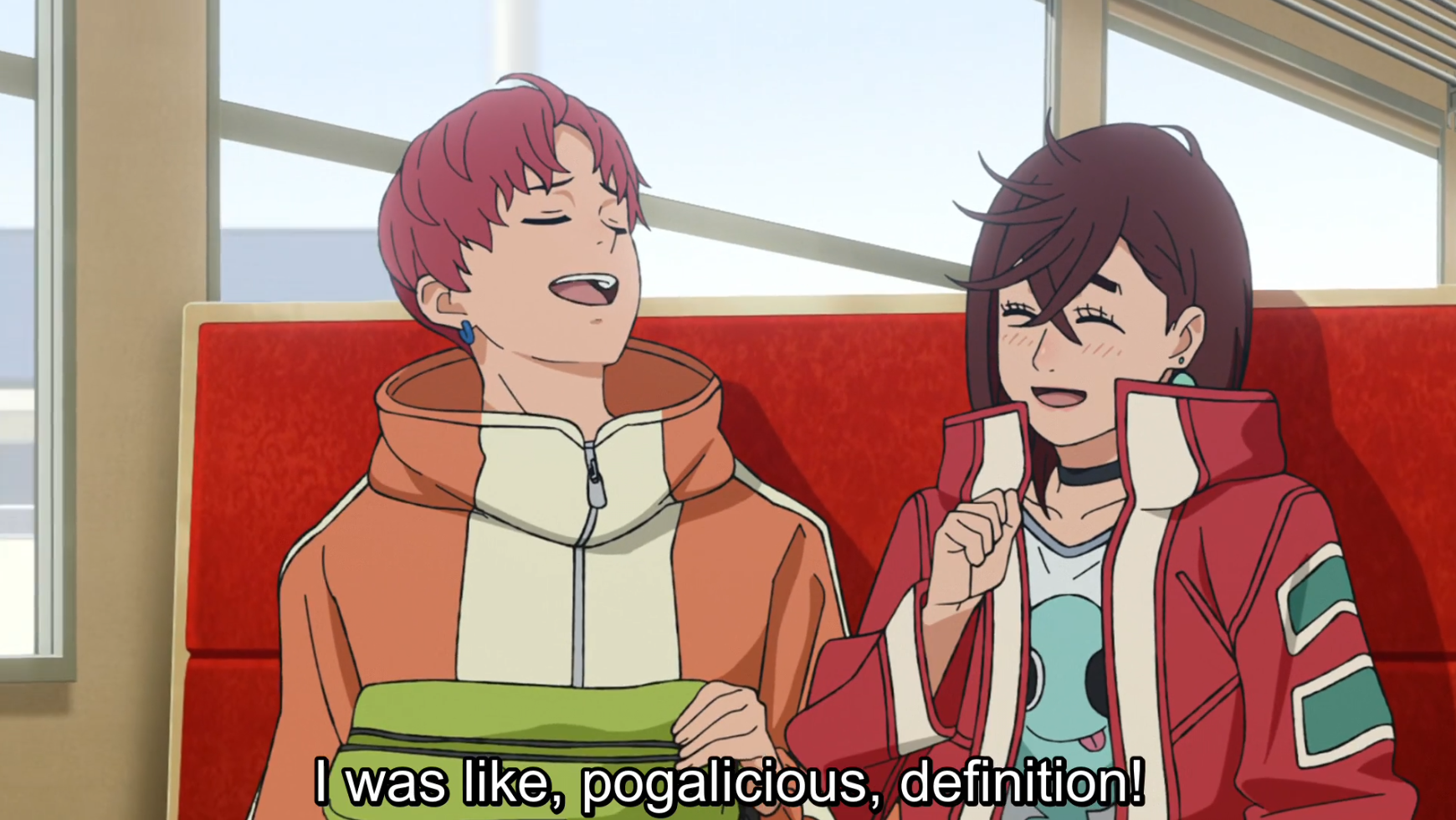
超感動しまクリーミーマミ!フォー!
I was like, pogalicious, definition! Wooo!
Okay, I get this line is really weird so I’m gonna take some time to justify it. Most of Jiji’s lines don’t require this level of innovation, but hopefully I can explain why this one is different.
So, context: Jiji and Momo are talking about a snack shop they used to go to as kids, and they’re feeling nostalgic about it since it’s still operating. They mention a specific old joke that the lady running it always used to say, and how she said it again when Jiji went back. Then Jiji says this line: 超感動しまクリーミーマミ!
超: Super, mega. It’s a common prefix in casual teen Japanese, similar to the “giga” in “gigachad”.
感動: To be moved. This word is used in common Japanese to mean “to be genuinely emotionally moved”, such as by a movie or an act of kindness. It’s also used more casually to convey less powerful feelings. Here, I think “pogging out” would be a fair translation given Jiji’s usual vernacular. Combined with 超, you could translate it as “pogging the fuck out”.
しまくり: The verb conjugation used for 感動. It usually means “to be in a continuous state of —” or “to — over and over again”. If we apply the effect to our previous translation, we’d get something like “I couldn’t stop pogging the fuck out” or “I literally couldnt stop pogging out”.
クリーミーマミ: Jiji makes a portmanteau of しまくり and クリーミーマミ for comedic effect. クリーミーマミ (Creamy Mami) was a magical girl anime from the mid-80s which has zero relevance to this scene.
Followers of the blog may be wondering why I haven’t translated the reference to “Creamy Mami” directly, given that I have gone to great lengths to preserve the (often obscure) references to Japanese culture throughout the series. There are 3 big problems with “Creamy Mami”: it doesn’t combine easily into the English grammar like it does with Japanese; the reference is meaningless and essentially a non sequitur so nothing of consequence is lost; and “Creamy Mami” sounds so explicitly sexual in English that it would confuse the viewer.
However, even if we don’t use the reference, we still need to substitute a reference. I wondered if the Creamy Mami choice was partly for the nostalgia factor, based on the nostalgic snack shop. I played around with this line for a bit before settling on a reference to Fergalicious. Fergalicious shares a nostalgia factor (though not as far in the past), and it’s also a feminine song, mirroring the femininity of a magical girl anime. It also portmanteaus well with “pog”, and is similarly “lolrandom”, fitting with Jiji’s dumb sense of humour.
Let me know what you think of these translations, or others you encounter in the episode! I’m very interested to hear other people’s takes. And thank you again to Chy for editing this project!