Dandadan Fansub Ep 8 Translation Notes
S01E08-Something Doesn’t Feel Right.mkv
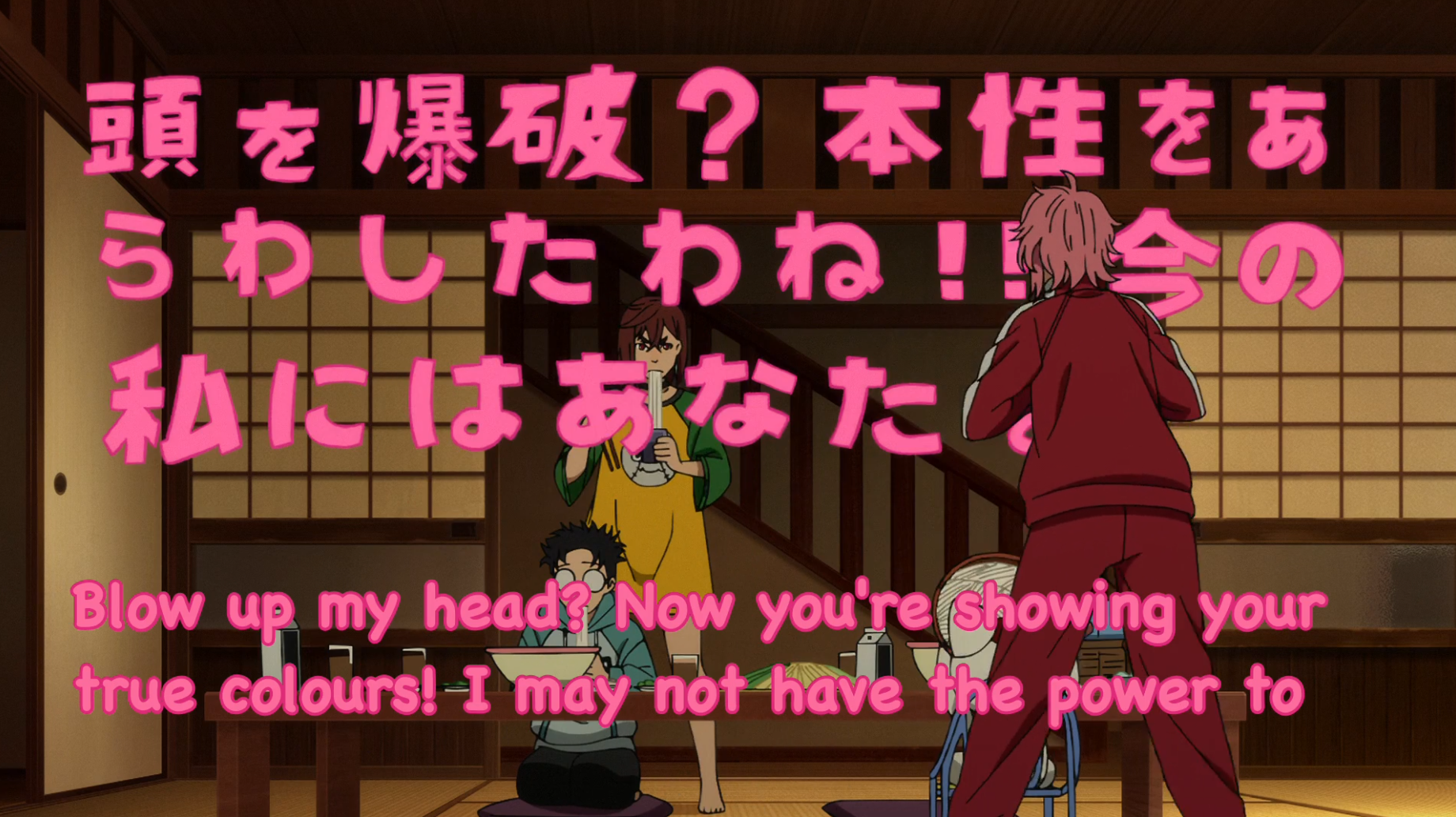
You might notice this episode has some pretty cool looking subs! While Momo and Aira are talking through their soumen, big Japanese subtitles appear on the screen character-by-character, like a typewriter. This was a challenge because I had to painstakingly line up each new English subbed word as the Japanese characters appeared on the screen. Interestingly, this also gave me a little taste of what it’s like to translate for dubs. The thing with dubs is that you need to match up translated words with the mouth flaps, and this is very similar to matching the translated words with the characters appearing on screen; the primary constraint being a hard limit on sentence length/syllable count.
中二病こじらせてんじゃねぇ〜〜〜よ!
Cut the YA fantasy protag bullshit!
I really liked this translation of 中二病 (chuunibyou: “Middle-schooler syndrome”). The word more specifically means “someone who acts like an 8th grader”, 中二 being an abbreviation of 中学二年 (middle school second year, which is equivalent to 8th grade in the anglophone school system). It conjures up images of cringy posturing and pretending to be an anime protagonist. I imagined that the word (as it applies to Aira) was very similar to how stereotypical young adult fantasy protagonists act, and when I saw how the subs looked with Momo saying it, I felt like it fit really well. A challenging Japanese concept mapped to a pretty close anglophone equivalent!
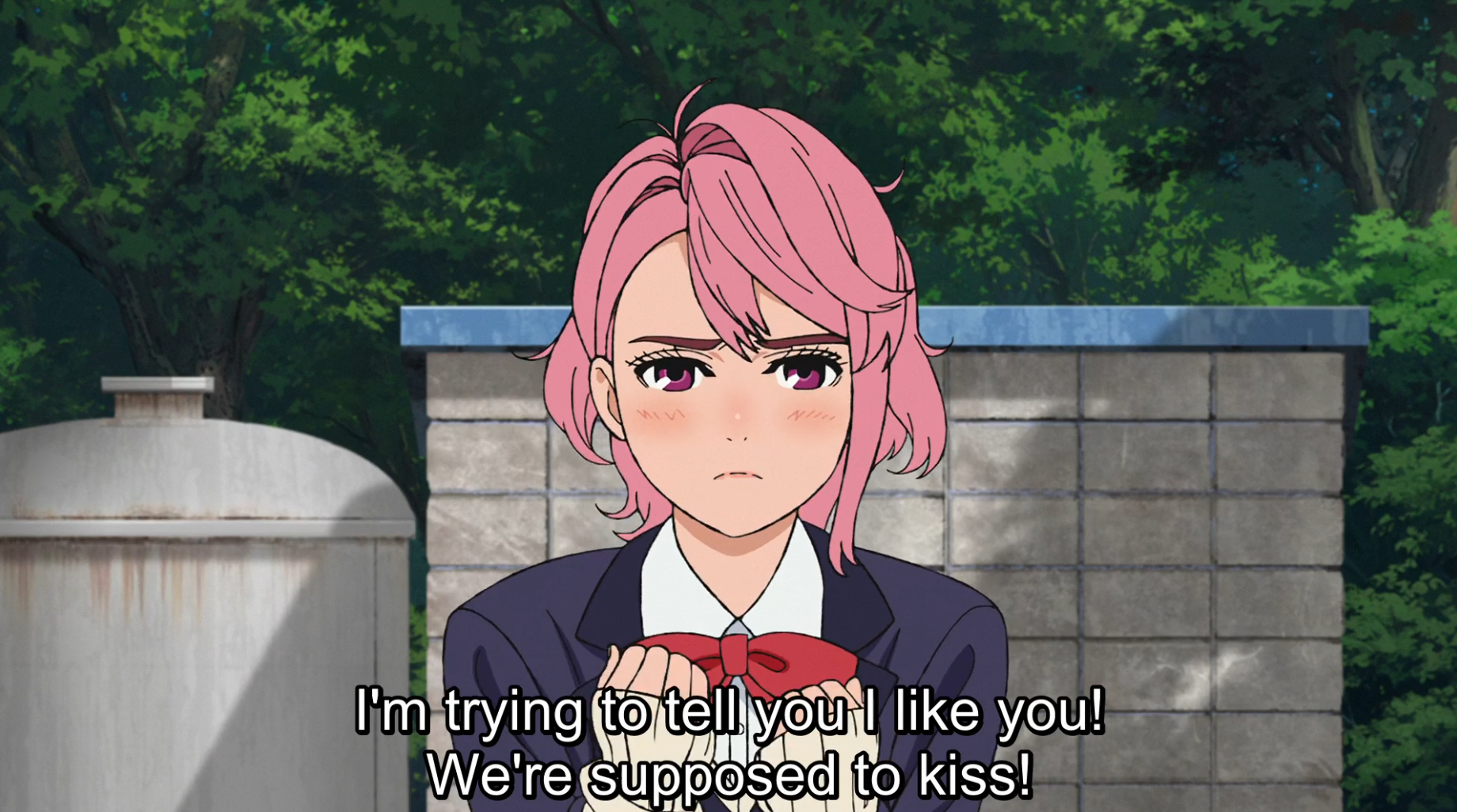
だって告白する時はキスしなきゃいけないでしょ!
I’m trying to tell you I like you! We’re supposed to kiss!
Man, I hate the word 告白 (kokuhaku: confession (of “love”)). Everyone likes to talk about how different Japanese teen romance is from anglophone teen romance, but if you look at it from a distance, is it really very different? When an English-speaking teen asks someone out, action is explicit (“Would you like to go out with me?”) while internal feelings are implicit. When a Japanese-speaking teen asks someone out, internal feelings are explicit (太郎さんのことが好き!) while action is implicit. But in both cases, all information, be it explicit or implicit, is intended to be communicated. To me, a Japanese 告白 is the same as asking someone out in English, it’s just that when surface level meaning is translated directly, it superficially appears to be different. But the cultural expectations and such are quite similar for both cases. Anyway, I never translate it as “confess”. In this line, I’ve translated it as “trying to tell you I like you”.
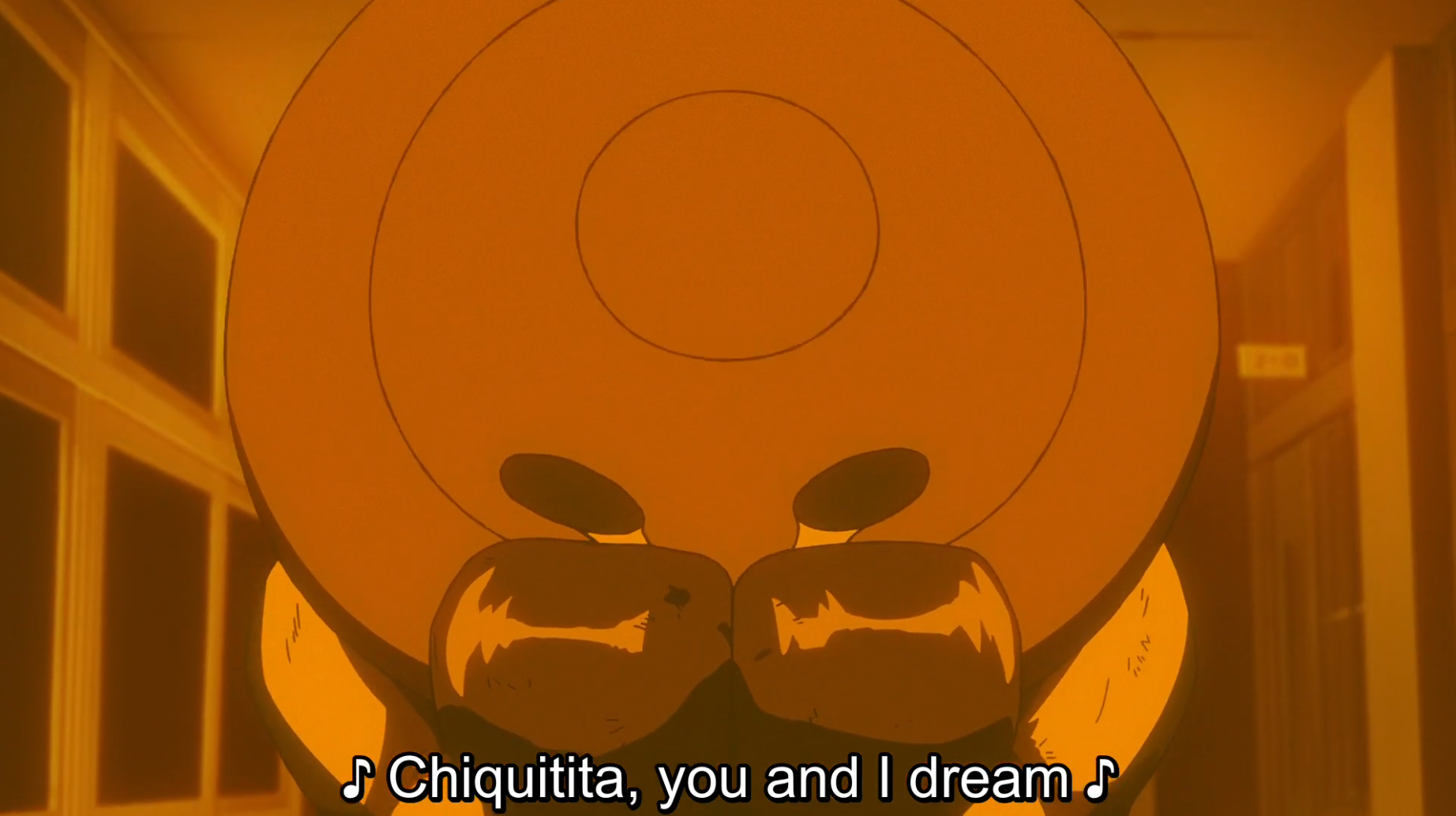
チキチータ、ユメないか
The mantisian’s Chiquitita song is an obvious ABBA reference, and this line in particular seems to be a joke based on how a Japanese speaker would mishear the English lyrics. It bears striking phonetic similarity to “Chiquitita, you and I cry”, but directly translated would mean something closer to “Chiquitita, don’t you have a dream?”. Also, there’s additional meaning imparted onto this line when it’s revealed that he’s singing about his son named Chiquitita. In order to translate that hidden meaning as well as the misheard/misremembered lyrics bit, I went with the following translation.
Chiquitita, you and I dream…
We see even more of this in the next episode, but the mantisian’s songs are quite reminiscent of working songs or shanties, and he’s certainly depicted as a working man. When possible, I prioritised making the songs sound realistically like an English working song rather than directly translating the lyrics.
Way, hay, east and west
Way, hay, north and south
Oh, morning, noon and night
Fight the gig worker fight