How long will the Japanese Wikipedia article for Goncharov last?
I was in a Wikipedia hole recently and I happened to notice that the Japanese article for Goncharov is the only language variant that is completely in-character.
Every other language specifies it as “Goncharov (meme)”. Japanese lists it as “Goncharov (1973 film)”, and formats the introduction as if it were a real movie:

Goncharov is a 1973 mafia film set in Naples, Italy. Produced by Martin Scorsese, the main cast includes Robert De Niro, Al Pacino, John Cazale, Gene Hackman, Cybill Shepherd, and Harvey Keitel.
— Wikipedia (my translation)
The rest of the article does go on to acknowledge Tumblr’s influence in Goncharov’s popularity, but every mention of this influence frames it as reviving the popularity of the supposedly real film. On two occasions the word 再燃 is used (the first kanji means “again” and the second kanji means “burn” - it means “rekindle” and can be similarly used in the metaphorical and literal sense, just like the English word “rekindle”).

Goncharov became particularly popular on social media as a result of a reblog of a Tumblr post in August 2020. The post depicted shows the title of the film (Goncharov) in place of a brand logo on a shoe, which were described as “knockoff boots”. The image post and the comment attached to the reblog, mocking the fact that the original poster had not seen the film, became an internet meme. In November 2022, a poster made by a fan of Goncharov was uploaded to the internet, and the film’s popularity resurged. Various fan-made content about the story and production began to spread on Tumblr and other platforms. Goncharov has been widely covered in the media as an example of how fandom is born on the internet, with many prominent figures, including Scorsese himself, leaving comments.
— Wikipedia (my translation)
It’s clear the article is trying to adapt the real history of the meme and incorporate it as much as possible into the fictional history of the film. The rest follows quite similarly, and includes more analysis of how Tumblr culture created the “reignited” popularity, how Elon’s acquisition of Twitter resulted in an exodus of users to Tumblr which may have contributed to the increased awareness of the “movie”, etc. Though most of it is directly translated from the English, enough of it is original (such as the attempts to reconcile both real and fictional histories) that I suspect the article’s current state is intentional.
To get back to my initial question, how long will this article last like this?
Remember the whole Scots Wikipedia debacle? An American teenager had basically used simple word replacement to translate over 23,000 articles into Scots. Some people noticed this, but not many, and not loudly enough. It was only after a well researched Reddit post pointed out the scale of the damage that people really took notice and action was taken. The Wikipedia editor had apparently been doing this for 7 years before the Reddit post was made.
If 23,000 articles could go largely unnoticed for 7 years, I imagine a single article could easily evade similar detection. Realistically, how many Japanese speakers are going to even hear about Goncharov and make it to the Wikipedia article? Then, how many of them are going to do more googling and find out it’s all a hoax (or know already)? THEN, how many of them are going to tell a Wikipedia admin that the article is a lie, or publicise it somehow in a way that forces the editors to update the article?
I think the reality is that although the internet may appear to be a massive open town square (or several), it also has side streets, and side streets of side streets. I feel like the number of active members in each online hobby or interest group are really quite small, and then they get divided between platforms, and even further divided into subgroups. I think if one decided it was something one wanted to do, it would be quite easy to become one of the most prevalent members of any online community you chose just by devoting the time and energy to it.
It’s also kind of shocking how much internet content is inaccessible on account of it being in a different language. English reigns supreme in terms of sheer volume, but there is original research and journalism and entertainment and art in every language, that hasn’t and might never be translated into English. For example, I found it very difficult to find any English sources or research for my post about the evolving conjugation of 違う, but I easily found several Japanese papers and websites. In fact, if you google “違くない adjective or verb”, the first English result that doesn’t just handwave it as “informal” or “slang” is a Tumblr blog with my post on it!
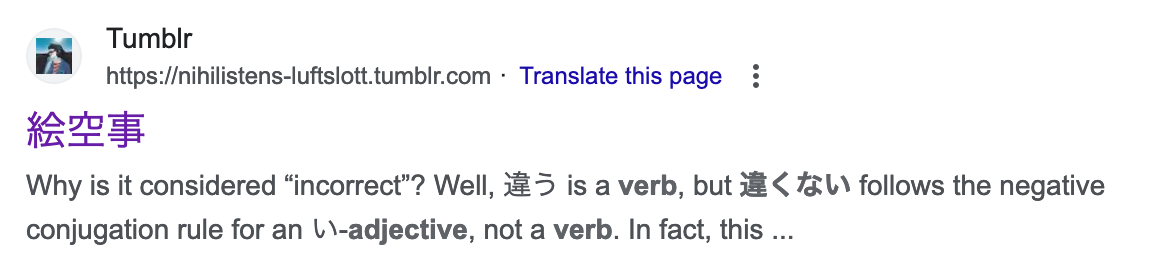
It’s a small internet indeed where my little hobby language blog is, according to Google, the prevailing English source on what is quite a remarkable change in Japanese grammar that’s been happening since the 80s.
I think the Japanese unreality version of the Goncharov Wikipedia article will stand for many years to come.