Utena Fansub Ep 1 Translation Notes
Revolutionary Girl Utena Episode 01 The Rose Bride.mkv
There were a lot of important decisions to be made in the first episode, since much of it is re-used in later episodes. In this post, I’ll discuss some of the translation choices I made around the fairy tale opening, and the use of 様 (sama).
王子様が呉れた指輪はやはりエンゲージリングだったのでしょうか。それは良いとして、お姫様は王子様に憧れるあまり、自分も王子様に成る決意をしてしまったのです。でも良いの本当にそれで?
Was the ring from the prince meant as an engagement ring? That part was good, but because of the strength of her admiration for the prince, the princess made up her mind to become a prince herself! But is that really good for her? (from ohtori.nu)
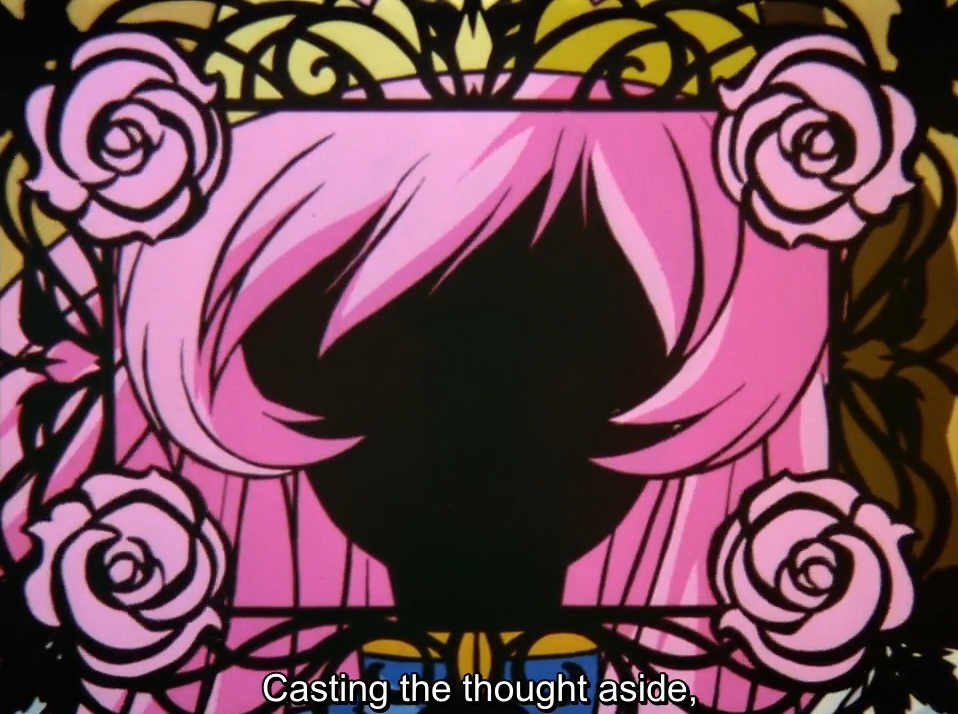
Perhaps the ring from the prince was meant as an engagement ring? Casting the thought aside, and overcome by an idolisation of the prince, the princess instead resolved to become a gallant prince herself! But is that really what she wants? (my translation)
「それはいいとして」 is an idiomatic phrase which, if taken literally, looks like it means “considering that good” or “that was good”. In reality, it means something more like “be that as it may”. A Japanese thesaurus gives synonyms such as 「それを置いといて」, which means “putting it aside for now”. It seems as though the translators from the ohtori scripts didn’t pick up on this nuance, which is surprising because they are usually quite accurate (if a little unnatural sounding).
憧れ (akogare) is a difficult word to translate here. It’s important that the translated word can’t be misinterpreted as the princess being infatuated with the prince. “Admiration” is ok, but it’s still sort of synonymous with love. 憧れ (akogare) contains notions of aspiration, it carries the implication of wanting to become like the target of their admiration, not simply being with them. This is why I chose to translate it as “idolisation”.
I see 「でもいいの?本当にそれで」 as a VERY important line in Utena. To read Utena as queer, this line from the narrator echoes words from straight cis people lacking understanding of someone’s desire to transition. This line is something you’d say to someone who came to a party and when you offered them a wide variety of options of drinks and food, they only took water - “Are you sure? Is that really what you want?” It’s suggesting that what she really wants, what she should really want, is to marry the prince, not become a prince. This line represents the world’s resistance to Utena’s gender non-conformity — even the narrator is questioning them!
girl: あーーーーー!ウテナ様ー!
girl: ウテナ様、あたしのタオルを使って下さい!later…
Anthy: 私は今、西園寺様の花嫁です。
girl: Aaaaaah! Utena is the master!
girl: Master Utena, use my towel!later…
Anthy: I am currently Master Saionji’s Bride.
One goal of my translation is to make it as accessible as possible to non-anime watchers, which means finding a good translation for 様(sama).
Why master? One good thing about it is that it’s vaguely masculine without being explicitly masculine (which 様 (sama) is not, but I like how this aspect assists with delivering some of the themes of the story). But more important than that, it can be used in the two critically important contexts 様 (sama) is used in — 1. as part of the Rose Bride’s obligation to show deference to the person she is engaged to, and 2. used by the schoolgirls who idolise Utena as a fun, affectionate nickname.
The Utena-sama nickname already exists among the girls at school before Anthy starts calling Utena that. Then the girls use it, they’re using it to jokingly emphasise how skilful and cool Utena is — a “basketball master”, a “master of cool”. This has a totally different connotation to the way Anthy uses it — she uses it sincerely, to show extreme deference to her literal master.
To establish this double meaning, I made cheeky use of what is essentially background dialogue. When the girls rush the basketball court to congratulate Utena, they scream “Utena-sama”, but I translated it as “Utena is the master”, which is then followed up with the first actual use of “Master Utena”.