Utena Fansub Ep 18 Translation Notes
Revolutionary Girl Utena Episode 18 Mitsuru’s Growing Pains.mkv
There’s a lot of ideas packed into this episode about patriarchy and what it means to become a man. This is an issue that I’ve personally done a lot of reflecting on, and also something I’ve been reading about recently with bell hooks’ The Will To Change, so this episode I’ll be doing a little more textual analysis than usual and comparing readings of Utena with bell hooks.
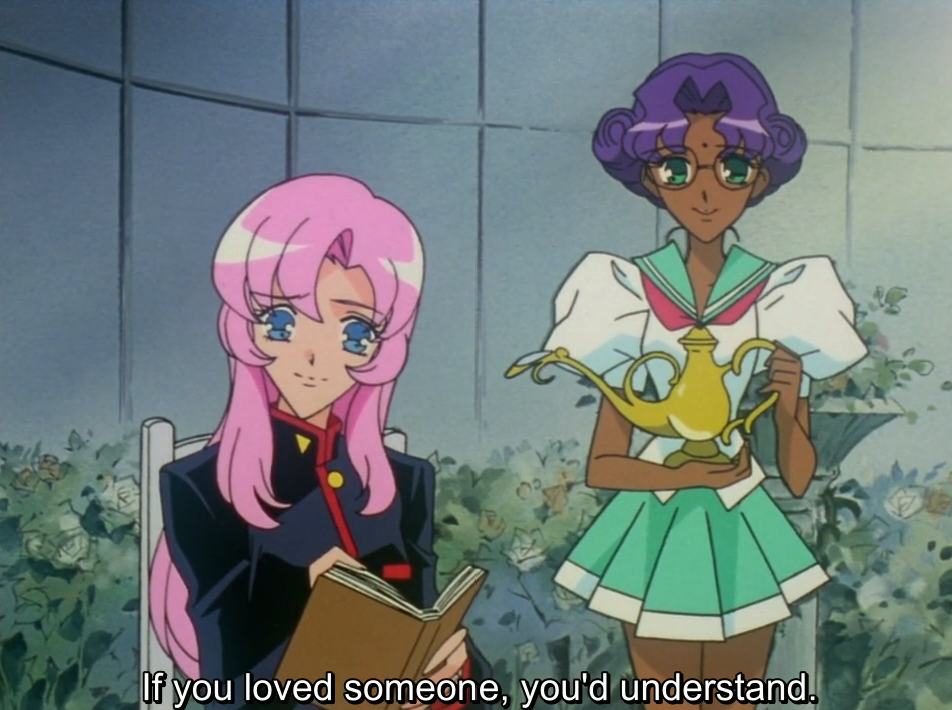
Utena: つわぶき君はよく続くなー。僕だったらあの生活三日も持たないや。
Anthy: きっと好きだからできるんですよ
Utena: I don’t know how he does it. I wouldn’t last three days being bossed around like that.
Anthy: If you loved someone, you’d understand.
This line is soooo revealing. It really shows how Anthy thinks about love. And god, the way she says it — so condescending to Utena with the んですよ. Like “you poor naive thing who has never experienced love, I know better than you do”. It sounds very “you’ll understand when you’re older”. And it tears me up inside to see Anthy believing that she is the one who knows better. Even Utena’s naivity is better than Anthy’s horrible warped idea of what love is. And obviously the reason Anthy essentially takes a stand behind the idea that love is unconditional servitude is because of her curse and her relationship with Akio. She is obliged to be at the beck and call of her betrothed, a position of love. And she has learnt from Akio that love is running yourself into the ground, from his time serving the people as Dios. And her relationship with Akio, a familial relationship that is traditionally one of love, is essentially slavery. What else can she do, how else can she live with herself, if not by telling herself that this is what love is meant to be?
A more literal translation of Anthy’s line would be something like “I’m sure he can do it because he loves her”. But her tone and phrasing in Japanese makes it clear that she’s extrapolating - she’s thinking that anyone in love would do the same. That’s why I translated the line the way I did.
I also tried “That’s just what love is” but it didn’t sound condescending enough. I needed Anthy to sound like Utena’s mum in this exchange, because that’s how she sounds in Japanese.
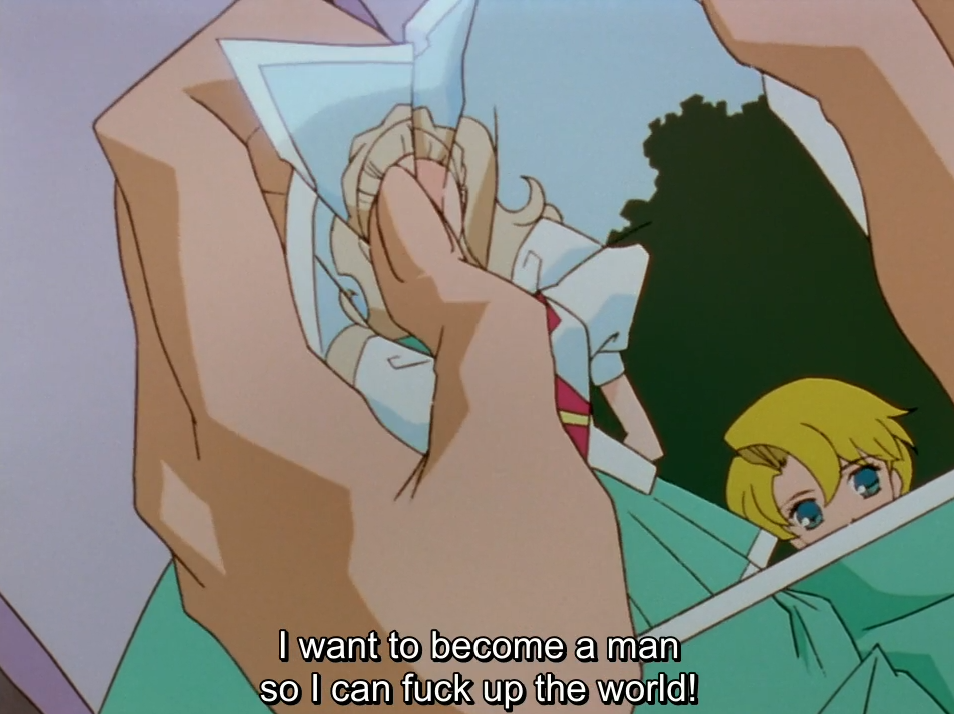
大人になりたい!大人になって世界をめちゃくちゃにしてやりたい!
I want to grow up! I want to become a man so I can fuck up the world!
Oh god oh fuck. What is happening to our little Mitsuru… who could have predicted this?! Well, bell hooks did:
Boys are encouraged by patriarchal thinking to claim rage as the easiest path to manliness. It should come as no surprise, then, that beneath the surface there is a seething anger is boys, a rage waiting for the moment to be heard. The Will To Change pp. 44
In isolation they lose the sense of their value and worth. No wonder then that when they reenter a community, they bring with them killing rage as their primary defence. pp. 43
The word めちゃくちゃにする is difficult to translate. It’s a word used often in casual conversation, so it doesn’t sound very formal or proper. It kind of means “to throw into complete disorder; to make everything a complete mess”. E.g.
その地震は何もかもめちゃくちゃにした
The earthquake destroyed/smashed up everything.
In this context though, “destroy” or “smash up” doesn’t work because we’re not talking about buildings and furniture, we’re talking about “the world”. Other translations try their best to translate this line without swearing (I want to become a man and wreck the world! // I want to be an adult and just kick over the whole world! // I want to a grown up, and just… just do whatever I want with the world!). But I really don’t think it’s possible. THE translation for めちゃくちゃにする in this context is “to fuck up”.
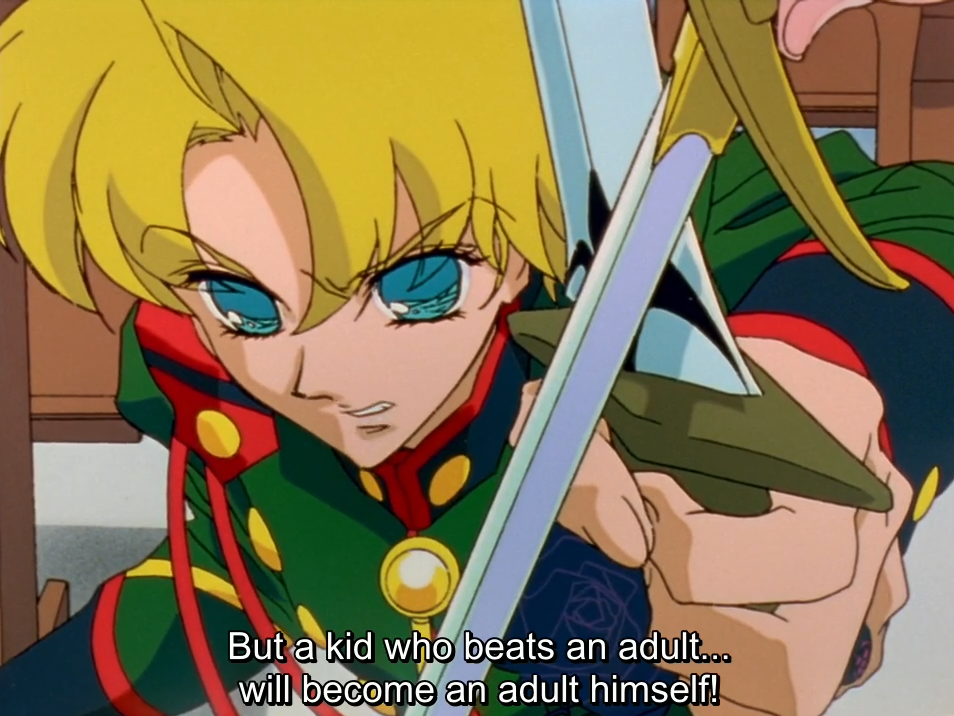
経験を積んだ大人を倒してこそ子供は大人になる
But a kid who beats an adult… will become an adult himself!
Maybe I’m reading too much into the word 倒す here, but allow me to digress: I don’t think this translation is particularly controversial. 倒す literally does mean “beat”. But I originally had this as “defeat”, a much less violent word (also used by the one of the translations I’m using as reference). However, I think “beat” is better for several reasons.
First, 倒す is a word that comes up a lot in anime and manga targeted at the 12-16 year old boy demographic. “Beat” is similar — “can superman beat goku in a fight?” It has the same schoolyard feel to it. Using a word like this emphasises Tsuwabuki’s boyishness.
Secondly, while 倒す means “to defeat”, this meaning is actually metaphorical. Its literal meaning is “to knock down/to fell”. I’m guessing the “defeat” meaning comes from its use in boxing, where knocking someone down is equivalent to defeating them. Because of this, the original Japanese could be interpreted more literally — Tsuwabuki wants to batter an adult, he wants to prove his manhood by beating a woman, by knocking her down. I think this reading is reinforced by Tsuwabuki’s violent patriarchal outburst in the Seminarium elevator.
Another except from bell hooks’ The Will To Change (emphasis mine):
Researchers found that boys agreed that to be truly manly, they must command respect, be tough, not talk about problems, and dominate females. pp. 42
And another:
Boys who are allowed to assume the role of “mini patriarch” are often violent toward their mothers. (…) Obviously, as small boys they do not have the strength to overpower their mothers, but it is clear that they see the use of violence to get their needs met as acceptable. pp. 61-62

As always, thank you to my editor @dontbe-lasanya for their amazing editing skills! This project wouldn’t be possible without you!
Remember to follow the blog if you want to stay updated with new episode releases. For all episodes released so far, go here:
Haru Dipthong’s Utena Fansub - Google Drive
Rose divider taken from this post