Utena Fansub Ep 23 Translation Notes
Revolutionary Girl Utena Episode 23 What Makes a Duellist.mkv
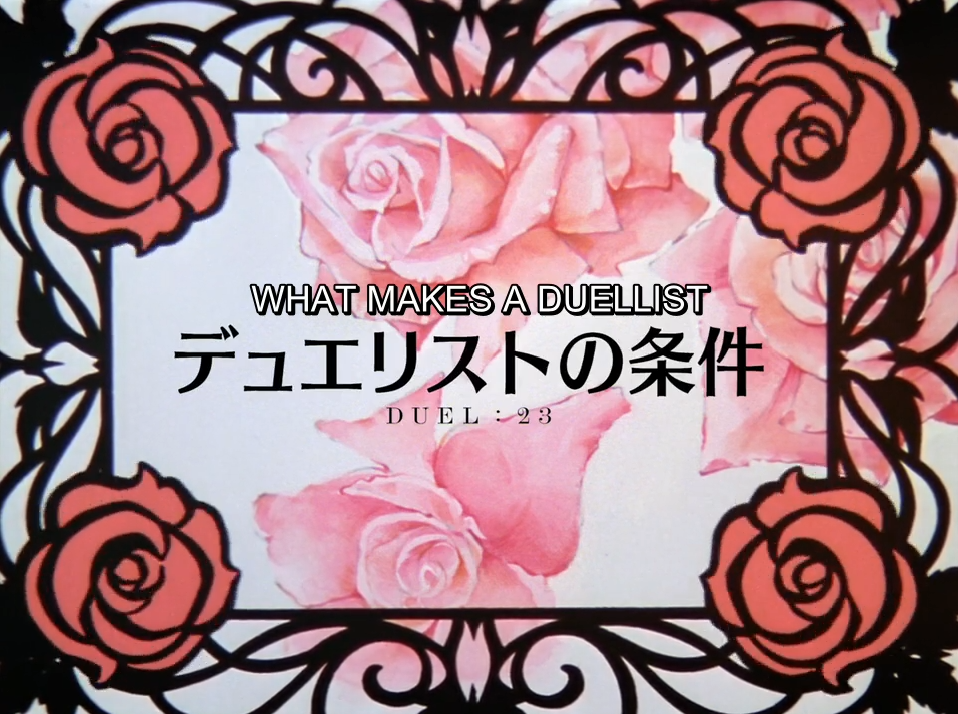
Another episode with a title change. I feel like I’m getting more liberal with these — I don’t think this one strictly had to change, but I prefer this translation over the original.
条件 can mean qualifications, conditions or requirements. For example, 条件付きの契約 (a contract with conditions), 一定の条件を満たす物件 (a property that meets my requirements). The phrase “Qualifications of a Duellist” evokes for me a stack of paperwork that a person has to complete before they’re allowed to duel, which isn’t right. The intended meaning is more like “What Qualifies One to be a Duellist”, but this is too verbose, so I reduced it down to “What Makes a Duellist”.
The reason I changed the title in this case was again because some of the dialogue calls back to the title, and I wanted to make those callbacks clear. In particular, this line:
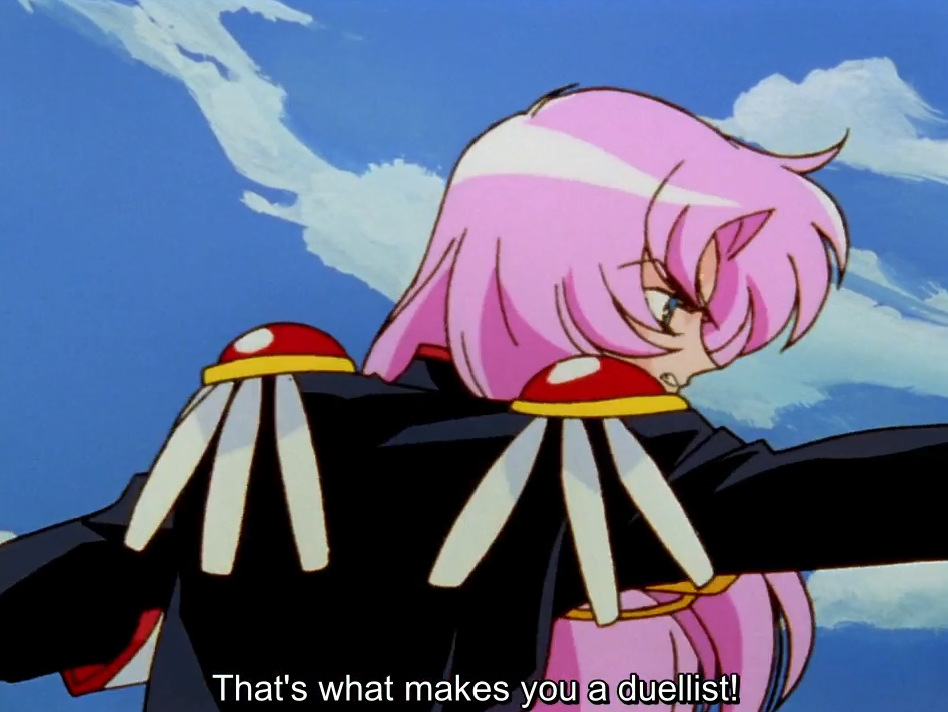
You met someone important to you, long ago. And your life was forever changed. That’s why you’re here. That illusion. That’s what makes you a duellist!
だから決闘場に入れたのさ!(lit. That’s why you can enter the Duelling Arena!)
Mikage doesn’t explicitly say the word 条件 here, but he is making the point that Utena’s fixation on their memory of the past is something that all duellists NEED before they can even enter the arena — in other words, a requirement, a condition (of entry). That memory is what makes one a duellist!
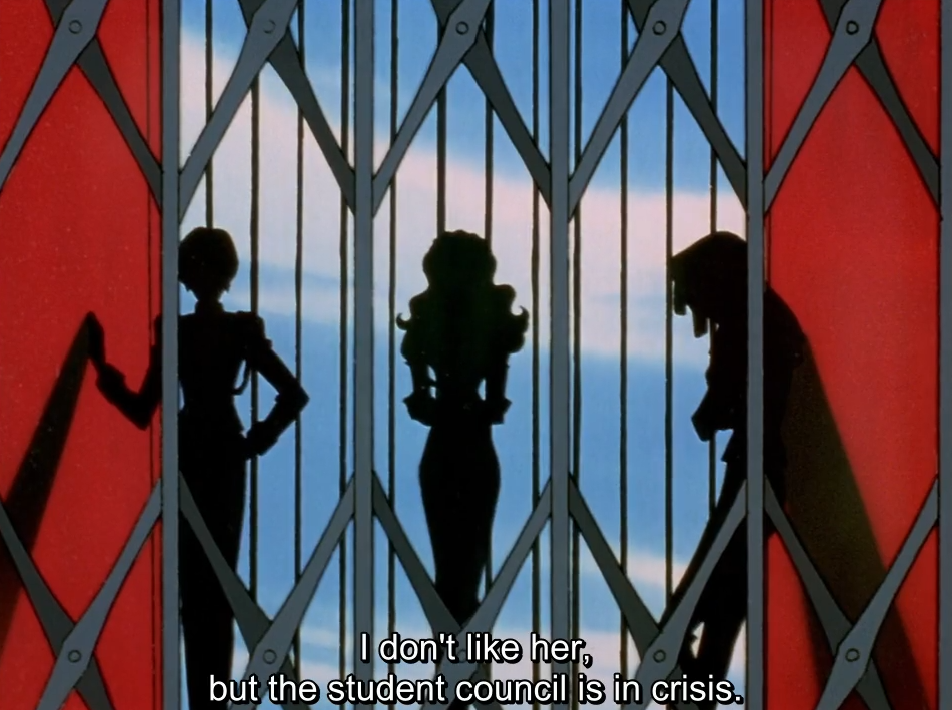
Miki: But I thought you hated them, Nanami.
Nanami: I don’t like her, but the student council is in crisis.
I’ve talked about pronouns a few times before, especially early on in the project, but it’s been a while since something like this has come up so I thought I might revisit my reasoning and strategy behind the conflicting pronoun choice for Utena here.
As the student council comes to accept Utena for who they are, I decided their use of a gender neutral pronoun for Utena would indicate their closeness with Utena as a friend and their understanding of them as a person. For Miki, he becomes friends with Utena and his use of the “they” pronoun is meant to indicate that he’s accommodating his friend’s identity, even if he doesn’t understand it.
For Juri, her use of “they” for Utena is more hostile. It’s a way of distancing herself from Utena. It’s her way of accepting that Utena is not “one of them” (as in a perpetuator of heteronormativity) but also not like her. I think Juri rationalises that Utena must not be a woman, since Utena is entitled to miracles and happiness (and Juri is not) despite seeing a shared queerness in the both of them.
Nanami still sees Utena as a woman at this point in the story. She hasn’t yet gone through a development that would allow her to gender Utena as nonbinary. That’s why we get this brutal exchange where Miki they/thems Utena, and Nanami pointedly contradicts that gendering with her own.
Of course, none of this exists in the Japanese because they rarely use third person pronouns (though Nanami does use 彼女 for Utena in this scene in particular). There is no passive-aggressive fighting over how to gender Utena. But I like this as a tool to compensate for the inability to translate Utena’s first person pronoun, so despite it not being something that explicitly exists in the original, these themes and ideas do exist, and I want to use them in an English language way.

@dontbe-lasanya did an particularly awesome job with the edit on this episode! Lots of really great changes that made it sound so much more natural!
Be sure to follow the blog if you’d like to stay up to date with new releases. For all episodes released so far, go here:
Haru Dipthong’s Utena Fansub - Google Drive
Rose divider taken from this post.