Utena Fansub Ep 4 Translation Notes
Revolutionary Girl Utena Episode 04 The Sunlit Garden Prelude.mkv
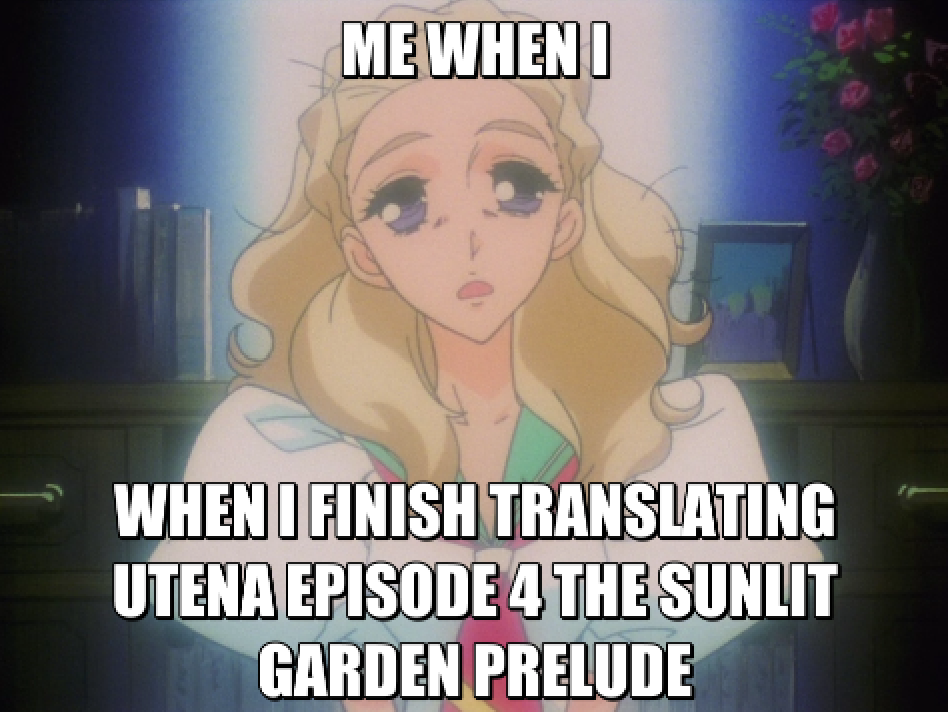
This has absolutely been the toughest episode yet. It has several difficult phrases, the most dialogue of any episode up to this point, and a few phases that are really important to future episodes and core themes.
This episode’s translation discussion
ねえ、じゅり先輩
Can I ask you something, Juri?
The bane of every translator’s existence — 先輩 (senpai). As I’m doing with 様 (sama), I definitely don’t want to include it untranslated as an honorific, but unlike 様 (sama) there’s no English word that could possibly be used in the same context to convey similar information. Instead, I’m trying to slip in some of the hierarchy in the characters’ general speech patterns. Here, the translation invents a whole sentence for Miki to show a bit of deference to Juri, instead of using the honorific.
—–
テクニックでねじ伏せるようないつもの迫力じゃなくて、なんだか音に潤いを感じるよ。
Your technique is usually so forceful and commanding, but today the notes have a kind of richness to them.
According to jisho.org, ねじ伏せる means “to twist someone’s arm and throw them to the ground”. 迫力 means “force, impact, strength”. Touga’s verbiage here is intentionally violent. It indicates that underneath Miki’s polite, almost feminine demeanour and appearance, lies a boy who is already being moulded by patriarchal forces into a force of oppression. It was important to keep that hint of Miki’s potential for violence and oppression in the translation.
—–
前に言ってた、輝くものでも見つけたのかな?
Did you ever find that “glow” you were talking about earlier? (from ohtori.nu)
It seems you may have found that guiding light you were telling me about. (my translation)
This was a really tough translation, and one that has implications for the future, because I believe 輝くもの is used when listing the council’s reasons for duelling in later episodes, so the translation I chose needed to fit in that context as well.
Depending on the kanji used, もの can mean either “thing” (物) or “person” (者). A Japanese transcript I found actually uses the “person” kanji excusively. So it could be translated as either “something that shines” or “someone that shines”. I think I managed to preserve this ambiguity in the translation: “guiding light” could be a literal light, or it could be a metaphor for a person who’s very important to you.
—–
自分の中に永遠の美しさを持ってないと引けない曲なんだ
It’s an ode to a beautiful life, where things never change. You need to believe in that to play it.
The Japanese literally translates to “This is a song [you/I] can’t play unless [you/I] carry [eternal beauty/the beauty of eternity] within yourself”. The subject of the sentence is omitted - is he talking in general or specifically about himself? Is 永遠 here acting as a noun (eternity) and の marks 美しさ as belonging to it (beauty of eternity) or is it acting in the genitive case and modifying the noun 美しさ instead (eternal beauty)?
These are all questions that matter in terms of making sense of the line, but not in the immediate sense of the translation, because the translation pivots on a different axis: 自分の中に…持ってないと. In english, translating this literally (carry … inside yourself) sounds unnatural. I think the Japanese gives more of an impression of carrying a worldview of eternal beauty; of seeing the world as a world that has eternal beauty. Textually, what Miki is talking about is carrying a dream of reliving the happiness of the past again, and then keeping it forever. He’s desperately trying to preserve that perfect time in his life, with him and his sister side by side playing that song in the sunlit garden. That’s actually what this is about. And his duelling loss, and the scene where the image of the garden shatters, represents him finally being forced to move on from that need for permanence.
Permanence (or as most translations have it, “eternity” — 永遠) is a core theme of the work. All of the characters, in some way, are trying to preserve a form of status quo, or regain and retain a status quo that has been lost to them. Though Miki uses the word 永遠 here, I decided not to directly translate it. Rather than relying on the recurrence of a single noun to carry this theme, I wanted to allow the theme to stand on its own merit. I think translating it variously as “permanence”, “eternity” and other edge cases as I’ve done in this line (“where things never change”), will allow me to better convey this theme of wanting to keep things as they are, and the necessity of change and of letting those things go.
—–
Thank you to my editor @dontbe-lasanya (I still can’t believe I get to say “my editor” lol), I’m sure it was as tough to edit as it was to translate!
For all episodes released so far, see the below drive folder. Be sure to follow the blog for updates if you want to watch along!