Utena Fansub Ep 27 Translation Notes
Revolutionary Girl Utena Episode 27 Nanami’s Egg.mkv
This episode may truly be one of my favourites, and these translation notes are going to show it. There’s just so much to discuss here. In fact, I want to discuss the song translations too, but that would really make this post too long, so I’m going to make a separate post about that.
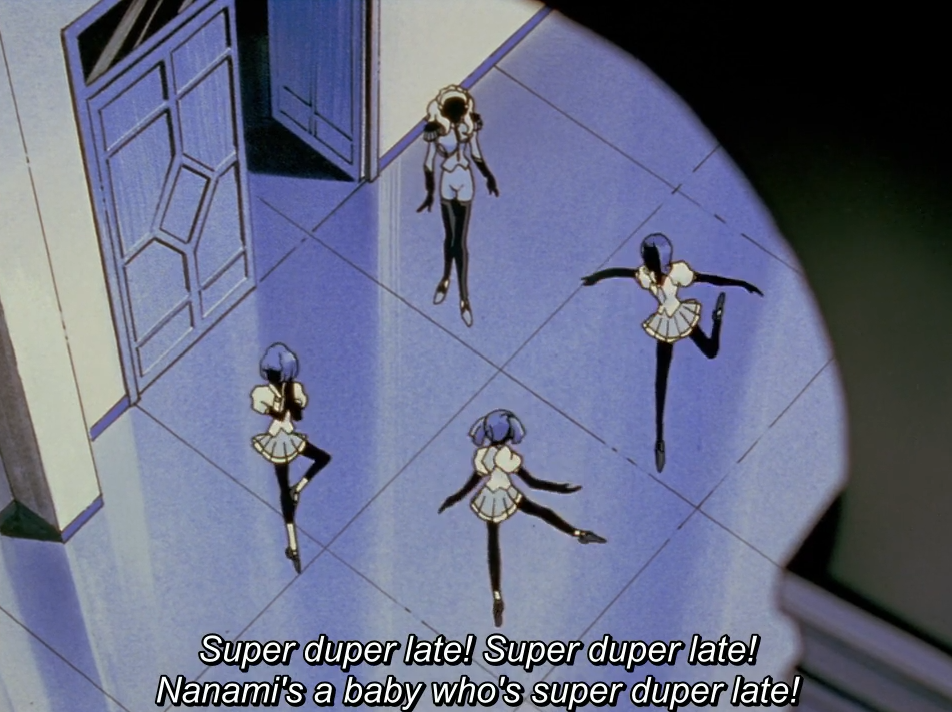
遅れてる!遅れてる!てるてる坊主のななみ様!
Super duper late! Super duper late! Nanami’s a baby who’s super duper late!
This one completely stumped Anya and me, because the Japanese on the third sentence makes NO SENSE. It literally means “Teru teru bouzu Nanami!” or “Nanami is a teru teru bouzu!”. Teru teru bouzu is a Japanese handmade cloth doll that’s used as a charm to ward off rain. There’s a nursery rhyme about it. But I couldn’t find any instances online of it being used as an insult like this. Anya found a loose connection between the teru teru bouzu and the Chinese legend of a broom-sweeping girl who gets abducted into the heavens in exchange for the rain to stop, and thought it could have been referencing alien abduction since Nanami is so worried about being called an alien. But this theory was tenuous at best and without a satisfying answer, I had to come to the conclusion that it’s just a nonsense word that kind of works as an insult and makes the juvenile teasing seem even more childish.
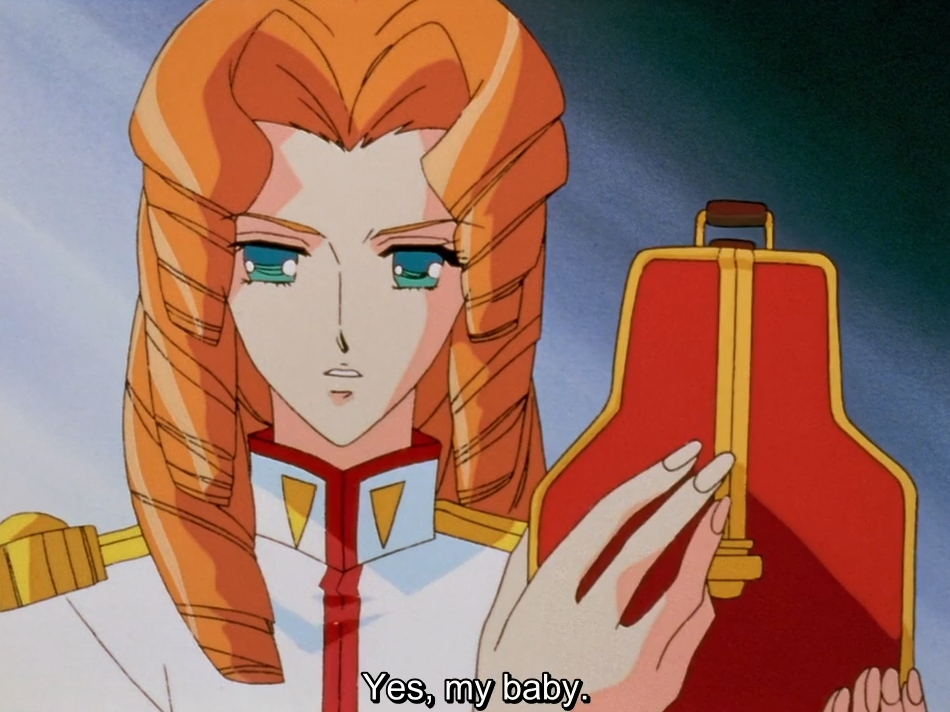
Juri: ななみ、気を付けてくれ。玉に傷がつくところだ。
Nanami: 玉?
Juri: そう、玉だ。
Juri: Nanami. Be more careful. You almost scratched up my baby.
Nanami: Baby?
Juri: Yes, my baby.
An impossible exchange. The joke in Japanese is that Juri says 玉 (tama: ball) but 玉 can also be short for 玉子 (tamago: egg). But you obviously can’t do this same wordplay in English!
I can’t take any credit for this one — it’s fully Anya’s idea. They mentioned the idea for the “baby” translation in DMs as early as the cowbell episode, and I thought it was brilliant. Juri would totally call her bowling ball “my baby”, and it perfectly allows for the confusion between Nanami and Juri.
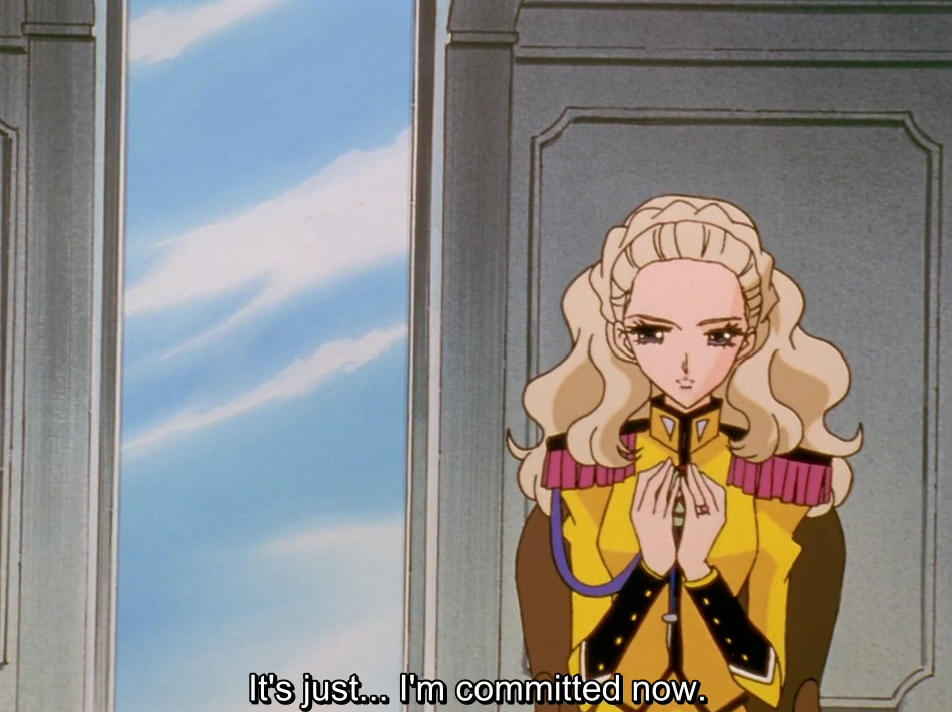
ななみは今、頑張っています。お兄様とわたくしの輝かしい未来のために。
It’s just… I’m committed now. Committed to making a bright future with you.
A very tricky instance of 頑張る (ganbaru) to translate. Often you’ll see this word translated as “doing my best”, which is essentially the act the word describes, but it sounds wrong in most scenarios. It can sound too… political campaign-y (e.g. ”I’m doing my best for you”) or just plain awkward or campy (e.g. the flashback scene with Keiko and co. — “From now on, let’s work together and give it our best shot!”).
Here, I believe Nanami is saying that she’s working hard, or prepared to work hard, as a mother. I believe “committed” encapsulates that meaning much better than “doing my best”. Of course, it doesn’t quite work without the follow up sentence to clarify the commitment, but as a whole line, I think it conveys the meaning really well and avoids a classic anime-english pitfall.
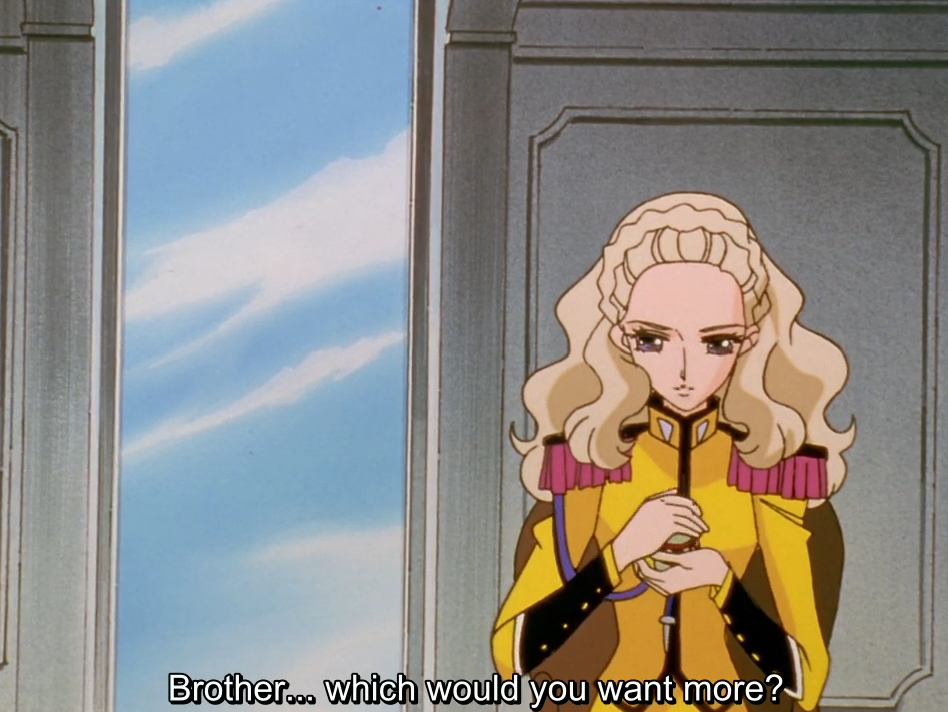
お兄様は… 男の子と女の子、どちらがいいですか?
Brother… which would you want more? A boy or a girl?
This translation is difficult because it requires the line to be able to read in two ways - is Nanami asking about sexual preference or preference for a child’s gender? Because of this, and because of the structure and phrasing of the Japanese sentence, it often gets translated as something like:
Which do you prefer, boys or girls? or;
Do you like boys or girls more?
But this has a high lean towards the sexual preference nuance. It’s rare that someone asking about the gender preference for a child would phrase the sentence in this way. That’s why I translated it the way I did. I think it still remains reasonable for Touga to interpret the question sexually (he is Touga after all), but it is much more plausible for Nanami to ask it like this.
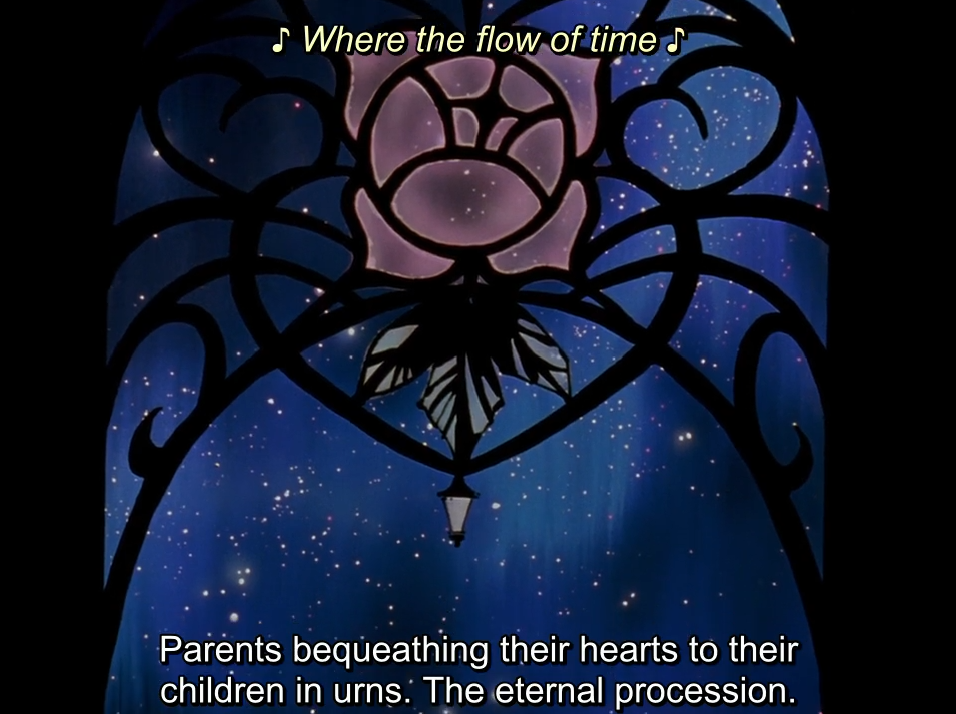
Anthy: 親から子へと永遠に受け継がれていく心の箸渡し。
Anthy: Parents bequeathing their hearts to their children in urns. The eternal procession.
What a line! Probably my favourite line in the whole episode, and it has some stiff competition. Let’s look at the structure of this sentence:
The long verb phrase 「親から子へと永遠に受け継がれていく」 is modifying the noun 「心の箸渡し」. And that noun is a doozy: it means “hashiwatashi of the heart” — and what is hashiwatashi? It’s a Japanese tradition of passing the bone fragments of a cremated loved one between funeral attendees using chopsticks to take the bone directly from the chopsticks of the person next to you. This is the only time it is acceptable in Japanese culture to pass anything between chopsticks, precisely because of this morbid association. This imagery is POTENT.
The verb phrase is “Parents eternally bequeathing their hearts to their children”, and the auxilliary verb いく at the end implies an active momentum, like it’s still ongoing. And what is meant by “heart”? Keep in mind that 心 also means “mind” and even “spirit”, and I take it to mean one’s selfhood. So we’re talking about how elements of a parent’s selfhood is always passed down to their children: though genes, through shared experience, through inherited habits, through familial bonds, through trauma.
So Anthy likens the passing down of the “heart” to a sombre and macabre ritual, which says something about how she views this idea. I imagine she views this bequeathment as a curse (ha); her focus is on the intergenerational trauma, and how it means that no one can be their “true” self because they inherit a heart that is not their own.
Meanwhile, Utena’s response (”You could say that leaving a part of yourself with your descendants is a form of reincarnation.”) shows instead an attitude of hope. It shows a coming-to-terms with death — Utena’s own, and that of their parents. And coming to terms with death is antithetical to the doctrines of eternity that Akio and the academy at large have been trying to sell, so I think this scene also foreshadows not only that Utena will prevail against the system and gain the power to revolutionise the world, but also how they will do so.
To say a bit more about my translation choices here: although hashiwatashi is untranslatable without a long cultural exposition dump, I did see it possible and necessary to convey the same grim funerary feeling through English words. “Procession” was the word I pivoted the entire translation around through many iterations because of its funerary associations and because it evokes an image of slow, reluctant forward movement.

Thanks as always to my amazing editor @dontbe-lasanya! Your passion for this episode really came through in the finished product.
Be sure to follow the blog to stay updated as new episodes are released. You can find all past episode releases here: